Why a visitor from AI search is worth 4.4x one from traditional search

Written by
Odin Lund
Category
AI search
Date
Share this article
What the 4.4x figure measures
The largest study of visitor value in AI search tracked more than 500 buying and research topics, each run as a traditional search and as an AI prompt, and followed the visits from each through to conversion. A visitor arriving from an AI answer converted at 4.4 times the rate of a visitor from an organic search result.
The figure compares conversion rates, so it describes how likely a visitor is to act. It counts people who clicked through from an answer, not everyone who read one, and it is an average across many categories, so your own multiple will be higher or lower. How to measure it is covered at the end of this piece.
The number matters because of what is happening around it. Clicks from traditional search results have fallen by around 20% since AI summaries started appearing at the top of the page, and about 60% of searches now end without a visit to any website. AI Overviews reach more than 2 billion people a month and ChatGPT more than 800 million a week. Traditional search volume is forecast to fall 25% by the end of 2026. The visits that survive this shift are fewer, and they carry more intent.
By the time someone clicks through from an AI answer, the buying decision has already been influenced. The model has named the options, weighed them and often recommended one. The visitor is not starting research. They are checking a recommendation they are already inclined to accept, and a page that confirms it converts them.

AI search converts better in every data set we found
The 4.4x study is one of several measurements published between mid-2025 and mid-2026, from very different audiences, and they all point the same way.
A software company measured AI search at 0.5% of its visits and 12.1% of its signups, a conversion rate roughly 23 times that of organic search.
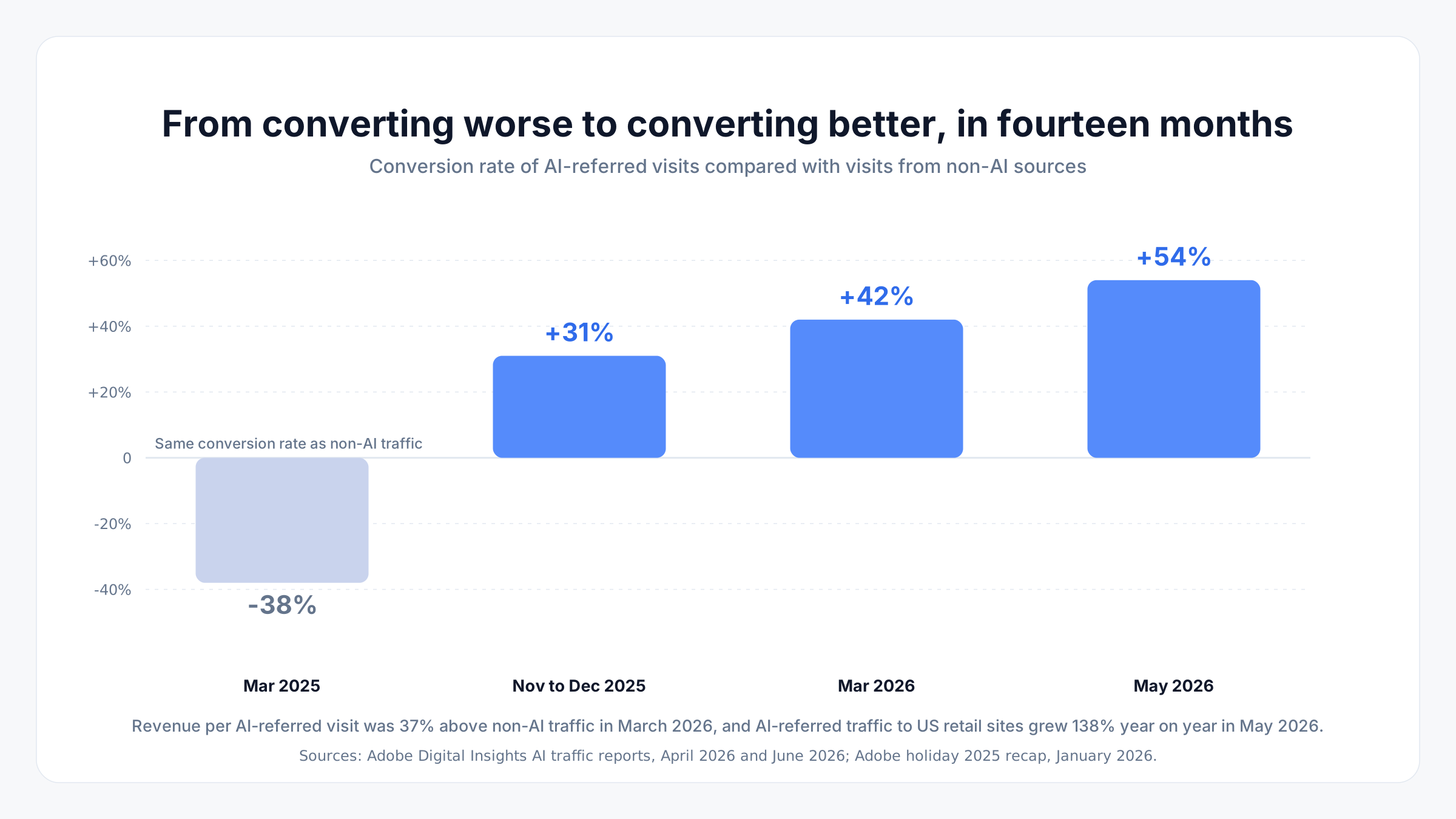
Across more than a trillion visits to US retail sites, shoppers referred by AI assistants converted 38% worse than other channels in March 2025 and 54% better by May 2026, with revenue per visit 37% higher.
In a survey of 1,117 US consumers, about 80% said they rely on AI summaries for at least 40% of their searches.
The cause is the same in each case. When most questions are answered inside the search, the people who still click are the ones the answer did not fully settle. They arrive with a specific question and a short list, and a page that answers the question converts them.
The retail series also shows that the multiple is not fixed. It moved by more than 90 points in fourteen months as the models got better at reading pages and as businesses made their pages easier to read. Over the same year the share of AI answers that link out to a source rose from 1.6% to 6.8%, and AI assistants now send about 9.5 billion web visits a month. More answers carry a link, and more people follow them.
Why AI search converts better
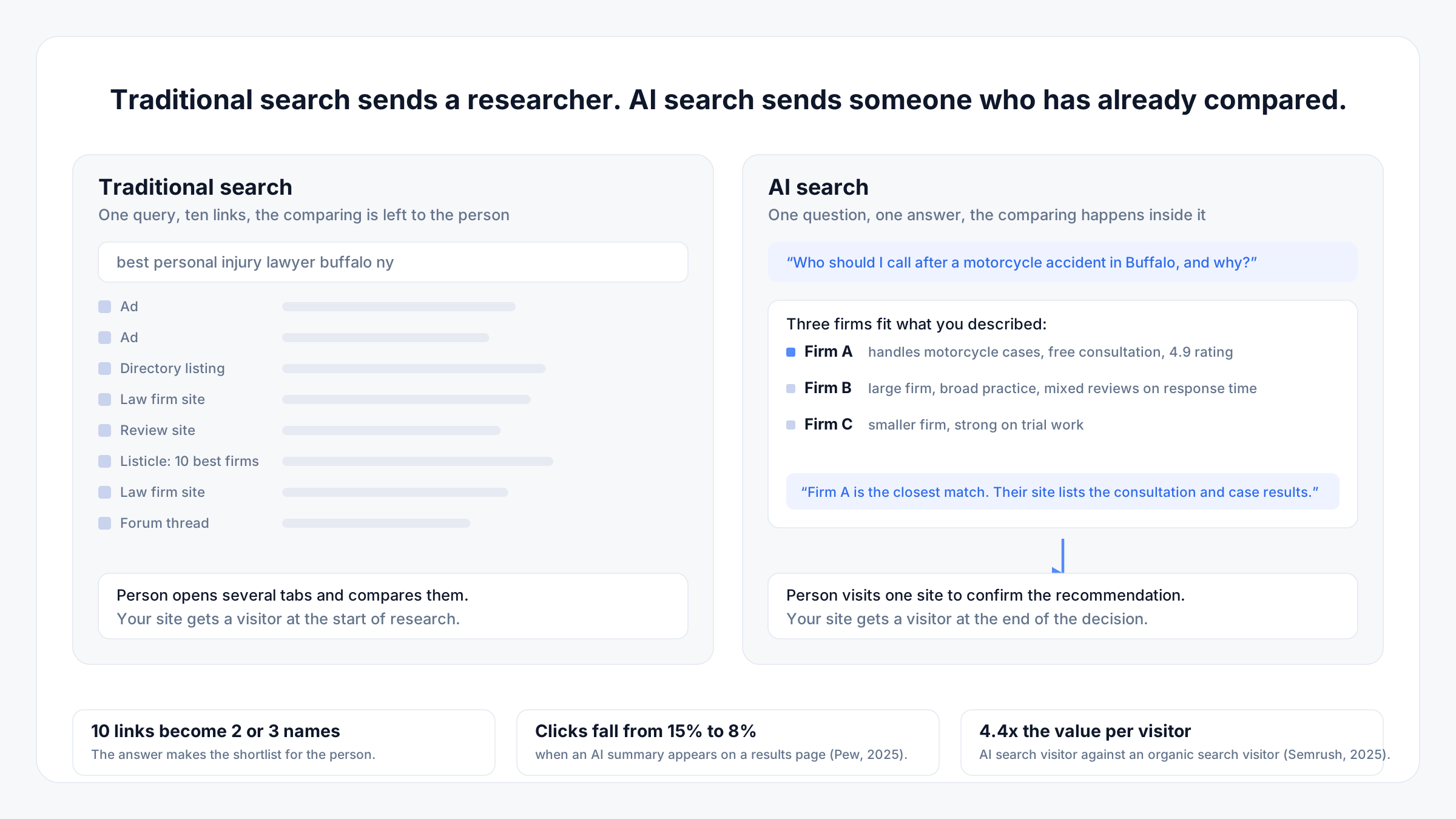
The person is the same. What changes is where in their decision they arrive.
The answer replaces the research phase. A search result sends a visitor at the start, with ten tabs open and a comparison still to make. An AI answer sends them at the end, after the shortlist and the comparison have happened in the conversation. In our own tracking of 60 customer questions across three models, the businesses named in the first answer were, with few exceptions, the ones compared and chosen later. Businesses missing from that first answer rarely re-entered.
The answer sets an expectation the page has to meet. A visitor told that a firm handles motorcycle cases in Buffalo and offers a free consultation arrives to confirm that, not to discover it. If the page confirms it, the visit converts. If the page contradicts it, the visit ends. Keeping your sources and your site consistent is therefore not only how you get named. It is how the click becomes a customer.
The visitor has qualified themselves. They asked a precise question in their own words and received a precise recommendation. The merely curious never clicked. That is why engagement rises with conversion. Visitors from AI answers spend about half as much time again on site and view more pages.
How we turn these visitors into customers, and sources
If the valuable visitor arrives at the end of the journey, the work happens before the click, in the answers and in the sources they are built from. That is where we work. The journey below is the map.
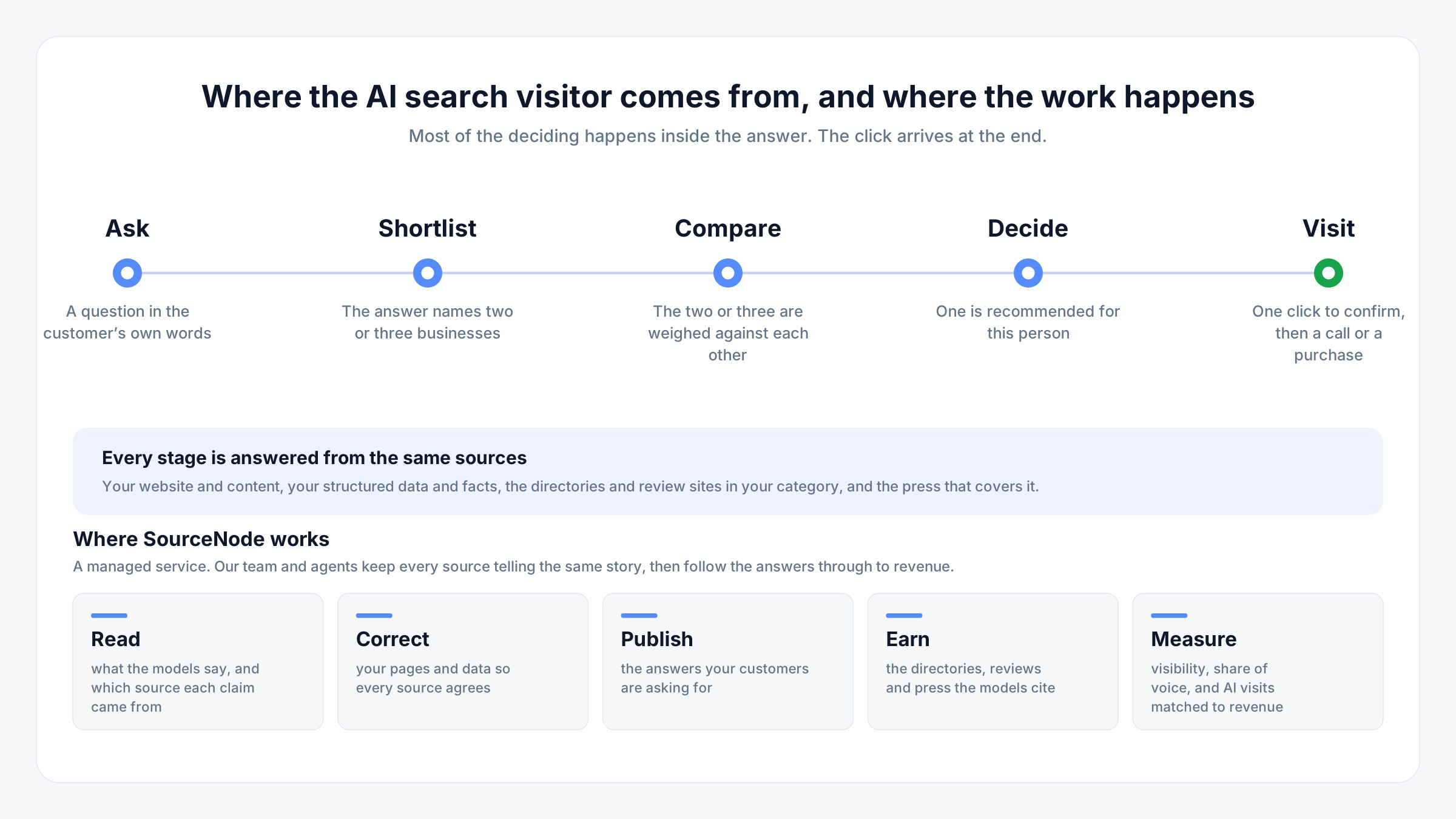
We read first. Every day we run the questions a business’s customers actually ask, on every major model, and record whether the business is named, what is said, and which page, listing or article each claim came from. We then correct the business’s own pages, schema and data so every source states the same facts, publish the answers customers are asking for in the formats the models retrieve, and earn or correct the directories, reviews and press the models rely on. Finally we measure visibility and share of voice by model and by stage of the journey, and match AI visits to leads and revenue, so the multiple becomes a number on the business’s own dashboard.
You can measure your own multiple now. Divide the conversion rate of visits referred by AI assistants by the conversion rate of your organic search visits, and track it monthly. The assistants identify themselves as referrers in your analytics. If the ratio is above one, the next question is how to appear in more answers, with facts your landing page confirms. Our earlier pieces cover the mechanics: how an AI answer is built, the six elements of an AI fingerprint and why the first question decides the shortlist. The product page shows how the work is reported, and a call shows what the models say about your business today.
Sources
Semrush, AI search study, July 2025: 4.4x value per visitor based on conversion rate, 500+ topics.
Pew Research Center, July 2025: 8% against 15% click rate with and without an AI summary.
Ahrefs, Patrick Stox, June 2025: 0.5% of visits, 12.1% of signups, 23x conversion rate.
Adobe Analytics holiday 2025 recap, January 2026: AI referrals converted 31% better.
Alphabet Q2 2025 earnings call, July 2025: AI Overviews monthly users.
OpenAI DevDay, October 2025: ChatGPT weekly active users.
Gartner, February 2024: traditional search engine volume forecast to drop 25% by 2026.
SourceNode tracking, 60 prompts, 14 firms, three models, June to September 2026.
Share Blog

